Picture this: It’s 2 AM, you’re editing your passion project, and the only thing missing is that perfect musical backdrop. You know the vibe you want—something between melancholic and hopeful, with a touch of electronic warmth—but hiring a composer isn’t in the budget, and stock music feels soulless.

This exact frustration led me down a rabbit hole of AI music generation tools over the past month. What I discovered surprised me: we’ve reached a point where artificial intelligence doesn’t just churn out background noise—it creates music that genuinely resonates. Some platforms impressed me with their intuitive design, while others delivered unexpectedly emotional compositions. Not every tool worked perfectly (I’ve had my share of bizarre outputs that sounded like a synthesizer having an existential crisis), but the best ones have fundamentally changed how I approach creative projects. Here are seven platforms that consistently delivered, starting with one that removes the biggest barrier to entry: cost.
Post Contents
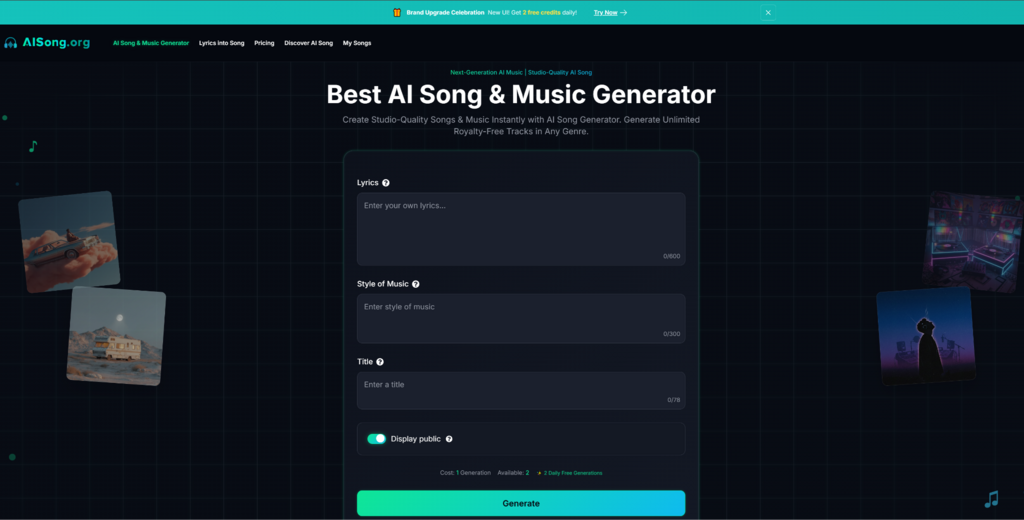
1. AI Song Generator
My journey began with AI Song Generator, primarily because I was skeptical that anything truly free could compete with paid alternatives. Three days and multiple experiments later, I found myself recommending it to fellow creators in my community.
What Sets It Apart
The platform’s philosophy centers on accessibility without compromise. Every registered user receives 2 complimentary music generations daily—no credit card required, no hidden fees, just straightforward creation [2]. All tracks come with royalty-free licensing, eliminating the legal anxiety that often accompanies content monetization [4].
During my testing phase, I experimented with diverse prompts ranging from “lo-fi hip-hop for studying” to “epic trailer music with rising tension.” The lo-fi track captured that dusty, nostalgic quality beautifully on the first attempt. The trailer music took two generations to achieve the dramatic build I envisioned, but the second version genuinely gave me goosebumps. The recent interface redesign makes the entire process feel conversational rather than technical [2].
What impressed me most wasn’t just the quality—it was how the platform interprets emotional nuance. When I requested “bittersweet acoustic guitar with subtle strings,” it understood the assignment in ways that felt almost intuitive. For creators operating on tight budgets or anyone exploring AI music without financial commitment, this represents remarkable value [4].
2. Suno AI
Suno has become something of a legend in AI music circles, and after extensive testing, I understand why. This platform excels at generating complete, radio-ready songs with vocals that occasionally made me forget I was listening to artificial intelligence [1] [2].
Core Capabilities
- Comprehensive song structure: Verses, choruses, bridges—fully arranged
- Vocal synthesis: Remarkably human-like across multiple genres
- Rapid generation: Full tracks typically ready in 30-60 seconds
The platform truly shines when you provide detailed creative direction. I tested this with a prompt: “indie folk ballad about leaving small-town life, female vocals, introspective lyrics.” The result included surprisingly poignant lines about highway lights and fading memories. Not every lyric was profound, but the overall composition had genuine emotional weight [1].
One limitation I noticed: overly broad prompts like “make me a pop song” tend to produce forgettable results. Suno rewards specificity and creative vision [2].
3. Udio
If Suno prioritizes speed, Udio prioritizes sonic excellence. In direct A/B comparisons using identical prompts, Udio consistently produced tracks with superior audio fidelity—deeper bass response, clearer separation between instruments, and more professional-sounding mixing [2].
Distinguishing Features
- Audiophile-grade output: Noticeably higher production quality
- Granular control: Detailed customization of musical elements
- Extended generation time: Quality comes at the cost of speed [1] [2]
I tested Udio with complex genres that typically challenge AI systems—specifically, a progressive metal track with odd time signatures. While it took nearly three minutes to generate (versus Suno’s one minute), the result featured intricate guitar work and rhythmic complexity that felt intentional rather than algorithmic. For projects where audio quality is non-negotiable—podcasts with discerning audiences, professional video productions, or personal music projects—Udio justifies its slower pace [2].
4. AIVA (Artificial Intelligence Virtual Artist)
AIVA occupies a unique niche: it’s built specifically for composers and filmmakers who need sophisticated instrumental music. Unlike vocal-centric platforms, AIVA understands classical composition theory, orchestration principles, and cinematic scoring conventions [1] [4].
Key Strengths
- Orchestral specialization: Exceptional at symphonic and chamber music
- Notation editing: Modify compositions at the sheet music level
- Flexible pricing: Free tier available; paid plans from $15/month [2] [4]
During testing, I requested a “melancholic piano solo inspired by Chopin.” What AIVA generated was genuinely moving—a three-minute piece with thoughtful phrasing and harmonic progression that felt emotionally coherent. I’ve used this track as background music during contemplative video segments, and multiple viewers asked where I licensed it.
The trade-off? AIVA struggles with contemporary electronic music or anything requiring modern production techniques. It’s a specialized tool that excels within its domain [1].
5. Soundraw
Soundraw reimagines the AI music workflow as a collaborative process rather than a one-click solution. The platform generates foundational tracks, then hands you extensive editing tools to refine every aspect [2] [3].
Notable Capabilities
- Layer-by-layer editing: Independently adjust melody, rhythm, bass, and accompaniment
- Stem separation: Download individual instrument tracks for external mixing
- Commercial licensing: Clear rights for monetized content
I particularly appreciated this approach when creating music for a client video. The initial generation was 80% there—great rhythm section, but the melody felt too busy. Rather than regenerating entirely, I simply toned down the melodic complexity while preserving everything else. This level of control bridges the gap between AI generation and traditional music production [3].
For creators who want AI assistance without surrendering creative authority, Soundraw offers an ideal middle ground [2].
6. Mubert
Mubert operates on a fundamentally different paradigm: instead of discrete tracks, it generates continuous, adaptive music streams tailored to exact duration requirements and contextual needs [1] [2].
Ideal Applications
- Platform-specific optimization: Pre-configured for YouTube, TikTok, podcasts
- Duration precision: Generate exactly 23 minutes and 47 seconds if needed
- Stylistic consistency: Maintains coherent aesthetic throughout
When I needed background music for a 38-minute podcast episode, Mubert generated a seamless ambient electronic track that evolved subtly throughout without becoming repetitive or distracting. This is where the platform excels: functional music that enhances without demanding attention [2].
However, if you’re seeking emotionally complex compositions or music as the primary focus, other platforms serve better. Mubert is the difference between a film score and elevator music—both valuable, but serving distinct purposes [1].
7. Boomy
Boomy distinguishes itself with an unexpected feature: built-in distribution to streaming platforms. You can generate a track, then push it directly to Spotify, Apple Music, or TikTok, earning royalties when people listen [3].
Unique Advantages
- Integrated distribution: Direct uploads to major streaming services
- Monetization potential: Earn royalties from AI-generated tracks
- Simplified workflow: Creation to publication in one platform
I experimented with this by generating and releasing a lo-fi instrumental album under a pseudonym. Three months later, it has modest but real streaming numbers—nothing life-changing, but proof that AI music can find genuine audiences [2] [3].
The caveat: Boomy’s generation quality doesn’t quite match Suno or Udio. It’s best suited for creators interested in music distribution as much as creation itself [3].
Feature Comparison
| Platform | Ideal Use Case | Free Access | Standout Feature | Consideration |
| AI Song Generator | Budget-conscious creators | 2 daily generations | Zero-cost accessibility | Results vary by prompt quality |
| Suno AI | Complete vocal songs | Limited free tier | Speed & lyrical content | Generic with vague prompts |
| Udio | High-fidelity projects | Limited | Superior audio quality | Longer generation times |
| AIVA | Film scores & classical | Yes | Orchestral expertise | Limited modern genre support |
| Soundraw | Hands-on customization | No | Granular editing control | Requires more time investment |
| Mubert | Continuous background music | Yes | Duration-specific streams | Less emotional complexity |
| Boomy | Streaming distribution | Yes | Built-in monetization | Lower generation quality |
Closing Reflections
After a month of intensive testing, I’ve learned that choosing an AI Music Generator isn’t about finding the “best” tool—it’s about matching capabilities to your specific creative needs and workflow preferences. If you’re exploring AI music for the first time without budget to spare, AI Song Generator removes barriers to entry while delivering genuinely usable results. If pristine audio quality matters more than generation speed, Udio’s superior fidelity justifies the wait. And if you’re scoring visual media with orchestral music, AIVA’s compositional intelligence remains unmatched.
The most valuable insight? Approach these tools with realistic expectations. Even the most sophisticated platforms occasionally generate tracks that miss the mark entirely—I’ve heard AI-produced music that sounded like a malfunctioning MIDI file. Success often requires prompt refinement, multiple generations, or creative editing. But when everything aligns—the right platform, a well-crafted prompt, and perhaps a bit of luck—the results can be genuinely inspiring.
We’re not witnessing the replacement of human musicians. We’re experiencing the democratization of music creation, where anyone with imagination can access the soundtrack their vision deserves. That shift feels less like technology disrupting art and more like technology expanding who gets to participate in making it.
Sources:
[1]: Reddit – Which is the Best AI Music Generator in 2026
[2]: LinkedIn – I Tried the Best AI Music Generators for 2026
[3]: Kraftgeek – Top 25 AI Tools For Musicians (2026)
[4]: Concept Beans – Top 11 AI Music Generator Tools 2026